
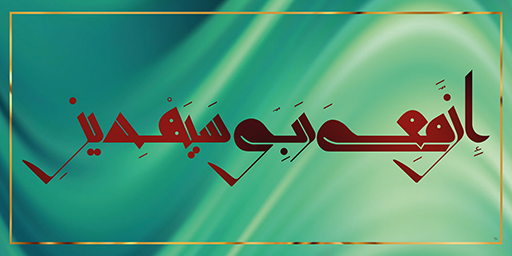
The word sabīl (way, path) appears repeatedly in the Qur’an in various contexts, which reflects the depth of this concept and the breadth of its meanings. Sabīl is not merely a physical road traveled by human beings; it may also refer to a path of guidance or misguidance, an ethical approach, and a social responsibility toward others.
📌 First : Sabīl as the Path of Guidance.
Allah, Blessed and Exalted, says:
“And when he turned toward Madyan, he said: ‘Perhaps my Lord will guide me to the right way.’”
(Surat Al-Qasas, verse 22)
This supplication was spoken by Moses, peace be upon him, during a moment of fear, exile, and uncertainty about the future. He asked God to guide him to the right path, meaning the straight and correct way.
A human being may know a geographical direction, yet still remain in need of God’s guidance in decisions, destiny, and choices.
📌Second: Straying from the Path.
Allah says:
“And whoever exchanges faith for disbelief has certainly strayed from the right path.”
(Surat Al-Baqarah, verse 108)
In this verse, sabīl refers to the path of faith and uprightness. Misguidance is not always ignorance of the path; it can also be the rejection of the path after it has become clear.
📌Third: One Path and Many Paths
Allah says:
“And this is My straight path, so follow it, and do not follow the other paths lest they separate you from His path.”
(Surat Al-An‘ām, verse 153)
In this verse, truth appears in the singular form:
“My path”
“His path”
Whereas the paths of deviation appear in the plural:
“the paths”
This shows that truth is one, while the ways of misguidance and division are many and scattered.
📌Fourth: Ibn as-Sabīl and the Social Dimension.
One of the deepest Qur’anic uses of the word sabīl is the expression: Ibn as-Sabīl (“the son of the road” / “the person of the path”) This expression appears in several verses among the categories of people whom God commands believers to support and assist financially. Here, the precision of the Qur’anic expression becomes evident: the Qur’an uses “Ibn as-Sabīl” rather than simply “traveler.” This distinction is important.
 The Difference Between “Travel” and “Sabīl” The Qur’an explicitly mentions travel in several places, such as: “And if you are ill or on a journey…” (Surat An-Nisā’, verse 43) The word “journey” directly refers to movement and travel. Sabīl, however, originally means “path” or “way.” Therefore, the expression Ibn as-Sabīl is deeper than merely “traveler.” A person may travel while remaining wealthy, safe, and stable. Ibn as-Sabīl, on the other hand, refers to a person whose condition has become tied to the road because of need, loss of means, and instability.
Who is Ibn as-Sabīl? In Arabic usage, the word “ibn” (son) can sometimes indicate attachment or association, not only biological lineage, such as: son of the night, son of war, son of the land.. Thus, Ibn as-Sabīl may be understood as the person for whom the road has become his condition and reality after losing the means of stability, safety, or support. The path here is no longer merely a road he passes through, but a place where he experiences vulnerability and need.
The Right of Relatives, the Needy, and Ibn as-Sabīl.
Allah says: “Give the relative his due right, as well as the needy and Ibn as-Sabīl…” (Surat Al-Isrā’, verse 26) And He also says: “So give the relative his due right, as well as the needy and Ibn as-Sabīl.” (Surat Ar-Rūm, verse 38) These two verses clearly show that the Qur’an does not speak of helping people in need as a mere optional favor, but rather as the fulfillment of an established right. The Qur’an affirms that :
✦ relatives have a right to care and support
✦ the needy have a right to assistance and a dignified life
✦ Ibn as-Sabīl has a right to aid and protection until stability is restored.
This expression preserves the dignity of the vulnerable person, because it does not reduce him to a mere recipient of charity, but recognizes him as the holder of a right that should not be denied. These verses also reveal a profound social dimension in the Qur’an, where worship and faith are connected to building a compassionate society that does not abandon the weak and vulnerable.
The Human, Social, and Legal Dimension of the Word “His Right”.
When Allah commands giving wealth to Ibn as-Sabīl, this reveals an important social dimension in the Qur’an. A person who stumbles along the road, or loses the ability to secure a dignified life, should not be left alone. This may include today :
✦ people whose means have been cut off
✦ people who have lost shelter and stability
✦ refugees and displaced persons
✦ needy individuals far from their families
✦ people left without protection or support
The phrase “his right” goes beyond occasional charity or individual generosity; it refers to a right that must be fulfilled and safeguarded. From this, we understand that protecting vulnerable groups is not only an individual responsibility, but also a collective responsibility involving society, public institutions, and authorities responsible for justice and social care. Here, the meaning of sabīl evolves from merely a path of guidance into a test of mercy, justice, and human solidarity.
