
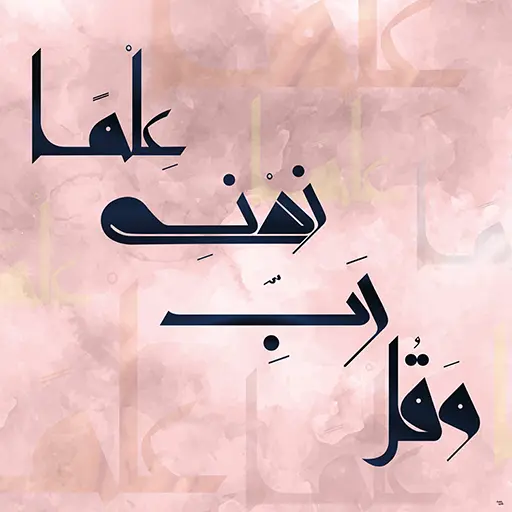
Allah, Blessed and Exalted, says:
“Exalted is Allah, the True King. Do not hasten with the Qur’an before its revelation to you is completed, and say: ‘My Lord, increase me in knowledge.’”
(Surah Taha, 20:114)
This verse is among the most significant passages concerning the status of knowledge in the Qur’an. Allah commands His Prophet Mohamed ﷺ to ask for an increase in knowledge, even though he was receiving divine revelation. This clearly indicates that the pursuit of knowledge has no end and that human beings, regardless of how much they learn, always need greater understanding and insight.
This Qur’anic supplication also teaches humility. True knowledge does not lead to arrogance; rather, it makes one aware of the limits of human understanding before the infinite knowledge of Allah.
📌First: Knowledge Is a Divine Gift
The Qur’an emphasizes that all knowledge originates from Allah and that human beings know only what He teaches them.
Allah says:
“And He taught Adam all the names.”
(Surah Al-Baqarah, 2:31)
Teaching Adam the names was the first sign of the honor bestowed upon him, even before his descent to Earth. The Qur’an does not link human dignity to physical strength or wealth, but to knowledge and understanding.
When Allah presented the names to the angels, they said:
“Glory be to You. We have no knowledge except what You have taught us. Indeed, You are the All-Knowing, the All-Wise.”
(Surah Al-Baqarah, 2:32)
This verse establishes a profound Qur’anic principle:
All knowledge possessed by human beings ultimately comes from Allah.
Therefore Allah says:
“You have been given only a little knowledge.”
(Surah Al-Isra’, 17:85)
And:
“Above every possessor of knowledge is One more knowing.”
(Surah Yusuf, 12:76)
No matter how much human knowledge expands, it remains limited before the boundless knowledge of Allah.
📌Second: Knowledge as the Foundation of Progress and Elevation
The first revelation of the Qur’an begins with:
“Read in the name of your Lord who created.”
(Surah Al-‘Alaq, 96:1)
Then:
“Who taught by the pen, taught humanity what it did not know.”
(Surah Al-‘Alaq, 96:4-5)
The Qur’anic message is therefore a call to reading, learning, and acquiring knowledge. It shows that human development begins with education and that the advancement of nations depends upon knowledge and understanding.
The Qur’an also links honor and elevation to both faith and knowledge:
“Allah will raise in rank those among you who believe and those who have been given knowledge.”
(Surah Al-Mujadilah, 58:11)
Faith provides values and purpose, while knowledge provides understanding, capability, and action. Knowledge without values may become a tool of corruption, but when joined with faith it becomes a means of reform and goodness.
📌Third: Knowledge and Reverence for Allah
Allah says:
“Only those of His servants who possess knowledge truly stand in awe of Allah.”
(Surah Fatir, 35:28)
This reverence is not mere fear. It is a deep awareness of Allah’s greatness gained through reflection upon His signs in the universe, in life, and within humanity itself.
The more a person learns about creation, the more they recognize the perfection of the Creator. Thus, in the Qur’an, knowledge is a path toward faith rather than its opposite.
📌Fourth: The Authority of Knowledge and the Development of the Earth
Allah says:
“O assembly of jinn and humankind! If you are able to pass beyond the regions of the heavens and the earth, then pass beyond them. You will not pass beyond them except with authority (sultan).”
(Surah Ar-Rahman, 55:33)
In Qur’anic language, sultan refers to power, capability, proof, and authority.
One manifestation of this sultan in our modern world is scientific knowledge. Through knowledge, humanity has discovered the laws of nature, developed transportation and communication, explored space, studied planets, and advanced medicine and engineering.
Yet the Qur’an reminds us that this authority is not independent of Allah’s will. Human beings do not create the laws of the universe; they discover and apply the laws that Allah has placed within creation.
📌Fifth: Knowledge and Human Stewardship on Earth
The story of Adam reveals that knowledge is closely linked to humanity’s mission on Earth.
After teaching Adam the names, Allah declared:
“Indeed, I will place upon the earth a steward (khalifah).”
(Surah Al-Baqarah, 2:30)
This demonstrates that stewardship is not based on strength alone, but on understanding, knowledge, and the capacity to learn.
For this reason, the Qur’an repeatedly calls people to observe, reflect, contemplate, and travel through the earth.
Industry, engineering, medicine, environmental sciences, and other beneficial fields of knowledge are all forms of cultivating and developing the Earth entrusted to humanity.
🔹Conclusion
The Qur’an brings together knowledge and faith within a unified vision. Knowledge is a blessing from Allah, a means of understanding the universe, a path to developing the Earth, a source of elevation, and a cause of insight and reverence.
This helps us understand the profound significance of the supplication:
“My Lord, increase me in knowledge.”
It is not a prayer limited to a specific age or field of study. Rather, it is a complete way of life. A believer remains a seeker of knowledge throughout life, humble before the greatness of the Creator, striving to acquire beneficial knowledge and to use it for goodness and reform.
The more knowledge a person gains, the more aware they become of their own limitations, the more they recognize the greatness of Allah, and the more capable they become of fulfilling the trust for which they were created: to worship Allah and to cultivate the Earth with justice, fairness, and excellence.
